Author: Patrice
✅ To remember when putting your Hino truck into service in Quebec: Choosing the right truck insurance (mandatory to drive on the road) Completing the SAAQ registration process Select the appropriate truck class Pass the SAAQ mechanical inspection Register with the Registry of Heavy Vehicle Owners Comply with load and dimension standards Keep mandatory documents on board the truck You’ve just bought a Quebec Hino truck and you’re lost in the administrative procedures? Insurance, registration, inspections, truck classes… Don’t stress, we’ll guide you step by step to get your truck into service without wasting time. Find out how to comply with SAAQ regulations, choose the right Quebec truck insurance and pass the SAAQ Hino inspection, even on an imported used vehicle. Head for Montreal, Laval or the South Shore: your Hino truck will be running legally tomorrow! Obtaining the appropriate commercial insurance Commercial insurance protects your Hino truck and your business. In Quebec, it must include third-party liability, accident benefits and legal protection. Without these coverages, it’s impossible to drive a Hino truck legally. Specialized insurers such as HUB International or Assur360 Tek offer packages tailored to local needs. HUB International – Commercial fleet expert with customized coverage Assur360 Tek – Digital solutions for truck insurance in Quebec Intact Assurance – National network and expertise in heavy transport Comparison of essential truck insurance coverage in Quebec Type of cover Status Risks covered Civil liability Mandatory Bodily injury and property damage caused to third parties Accident Benefits Mandatory Medical expenses and loss of income after an accident Legal protection Mandatory Defense in the event of a claim-related dispute Cargo Optional Loss of or damage to transported goods Property damage Optional Hino truck collision repairs To simplify the process, call us today at 450-641-1115. Our experts will help you choose the best insurance for your Hino truck, whether you’re in Montreal, Laval or on the South Shore. Registering with the SAAQ The SAAQ registration process for your Hino truck begins with the submission of mandatory documents. You’ll need valid proof of insurance, the vehicle’s certificate of origin and official identification. If your truck exceeds 3,000 kg, head to an SAAQ center to finalize the process. If you’re located on the South Shore, contact Hino Boucherville for personalized assistance with your administrative formalities. Choosing the right truck registration class Hino trucks in Quebec are registered according to their gross vehicle weight rating. Above 4,500 kg, Class 3 applies to commercial trucks. Choose according to use: local or regional transport with a certified heavy-duty vehicle. The SAAQ requires registration in the Registre des véhicules lourds for professional activities. Truck registration renewal costs: General freight – Commercial vehicles 2 axles3001 kg to 4000 kg 2-axle4001 kg and over 3 axles 4 axles 5 axles 6 axles and more Insurance contribution (incl. tax) 129,78 $ 129,78 $ 248,41 $ 248,41 $ 417,68 $ 417,68 $ Fees 5,35 $ 5,35 $ 5,35 $ 5,35 $ 5,35 $ 5,35 $ Registration fees 525,00 $ 911,00 $ 1 581,00 $ 2 320,00 $ 2 831,00 $ 3 880,00 $ Total 660,13 $ 1 046,13 $ 1 834,76 $ 2 573,76 $ 3 254,03 $ 4 303,03 $ Cost of registration renewal: General freight – Farm vehicles 2 axles3001 kg to 4000 kg 2-axle4001 kg and over 3 axles 4 axles 5 axles 6 axles and more Insurance contribution (tax included) 87,40 $ 87,04 $ 127,95 $ 127,95 $ 206,27 $ 206,27 $ Fees 5,35 $ 5,35 $ 5,35 $ 5,35 $ 5,35 $ 5,35 $ Registration fees 231,00 $ 387,00 $ 663,00 $ 960,00 $ 1 216,00 $ 1 632,00 $ Total 323,75 $ 479,75 $ 796,30 $ 1 093,30 $ 1 427,62 $ 1 843,62 $ Initial inspections required for Hino trucks Imported or used Hino trucks must pass an SAAQ inspection inspection before being put on the road for the first time in Quebec. This inspection ensures that the vehicle complies with Quebec safety standards. It covers braking systems, tires and visibility features. To avoid delays, discover the steps of the SAAQ mechanical inspectionmechanical inspection, designed to validate the conformity of your Hino truck. This process is crucial for both new and used vehicles. Brakes – Checking disc and pad efficiency and wear Tires – Checking tread condition and optimum pressure Steering – Inspection of steering components and excessive play Lighting – Testing low beam, brake lights and indicators Structure – Analysis of body and chassis for critical defects Failed SAAQ inspections are often the result of faulty brakes or worn tires. Call us today at (450) 641-1115 to anticipate necessary repairs and pass your SAAQ inspection in Montreal, Laval or on the South Shore. Registration in the Register of Owners and Operators of Heavy Vehicles Owners of Hino trucks in Quebec must register with the Registre des propriétaires et exploitants de véhicules lourds. This mandatory process, managed by the Commission des transports du Québec, validates the vehicle’s legal compliance. Provide the required documents to obtain the attestation and drive legally. Documents to keep in your Hino truck Always keep the registration certificate and proof of insurance on board your Hino truck in Quebec. The safety patrol report and daily log must also be available. Failure to do so can result in fines from the Commission des transports du Québec. Checking loads and dimensions for your Hino truck Your Hino truck in Quebec must comply with weight and dimension standards. In Quebec, a 19T forwarder can support 20 pallets, but no more than 2.55 meters in width. A SAAQ inspection validates compliance. Exceed these limits and you risk fines or delays in Montreal, Laval or on the South Shore. Thanks to their robustness and adapted design, Hino trucks easily meet Quebec requirements in terms of loads and dimensions. Regular checks prevent accidental overloads or overruns. Call us today at(450) 641-1115 to check specifications and avoid the penalties associated with a non-compliant vehicle. Comparison of insurers for heavy vehicles in Quebec Choosing between insurance, registration

✅ Express summary: How to reduce the fuel consumption of your Hino truck: Drive smoothly: up to 20% fuel savings Maintain a constant speed: ideally 80-90 km/h depending on the model Check tire pressure: under-inflation = +5% fuel consumption Change your filters regularly: up to 25% savings with a clean filter Optimize truck loading: 1 tonne less = -5 to -10% fuel savings Plan your routes intelligently: avoid Montérégie traffic jams Limit air conditioning: it can consume +25% in urban areas Regular engine maintenance: oil change, oil, brakes = + reliability Track your consumption with a dedicated tool: identify discrepancies Test alternative fuels: B20 biodiesel, additives or premium fuels Tired of your Hino truck’s exploding fuel budget? Find out how to reduce the fuel consumption of your Hino 195, 268 or other truck, thanks to fuel-efficient driving tips and precise mechanical maintenance. We’ll show you concrete ways to reduce your liters per 100 km, preserve your engine and adapt your driving style to the roads of Montérégie and Laval. Drive smoothly to save fuel Aggressive driving increases the fuel consumption of a Hino truck by 20 to 40%. By avoiding hard acceleration and late braking, you preserve the reliability and robustness of Hino trucks, thus reducing fuel consumption. Smooth styling also optimizes fuel efficiency. Accelerate smoothly to avoid unnecessary overspeeding. For a Hino truck, shift up quickly without forcing the engine speed. This eco-driving technique reduces average fuel consumption by 15 to 25%, depending on the Hino model. Anticipate deceleration to avoid sudden braking. Use engine braking rather than the brake pedal to conserve kinetic energy. In Montérégie and Laval, these practices limit speed variations, reducing fuel consumption by 20%. In the Montérégie region, Laval’s varied roads and hilly terrain (altitude between 4m and 65m) call for adapted driving habits. With a Hino truck, you cansave 3 to 5 liters over 500 km by driving at a constant speed and with greater anticipation. Maintain a constant speed on the road Frequent speed variations increase fuel consumption of Hino trucks by 20-40%. Regular styling reduces overspeeding, optimizing fuel efficiency. Stable speed maintenance avoids fuel consumption peaks due to repeated acceleration. Cruise control is useful on freeways and flat terrain. It is activated above 50 km/h via the steering wheel controls. In the Montérégie region, deactivate it in rough or icy conditions for greater safety. Here are the optimum speeds recommended for each Hino truck model: Hino 195: 80 to 90 km/h unladen, 70 to 80 km/h fully laden Hino L6: 90 to 100 km/h without load, 80 to 90 km/h with standard load Hino XL8: 85 to 95 km/h on highway, adjust according to terrain in Montérégie These ranges improve average fuel consumption, depending on the transmission and weight carried. Good route planning prevents traffic jams. Use tools like Google Maps or Mappy to get around traffic jams. In the Montérégie region, use main roads to keep your speed constant. In Quebec winters, reduce your speed and stay away from other vehicles. Mandatory winter tires (December 1 to March 15) improve grip. On winding roads, adapt your speed at bends and intersections. Check tire pressure regularly Insufficient pressure increases tire rolling resistance. A drop of 0.3 bar results in 6% more resistance. Under-inflation of 20% increases fuel consumption by 5%, according to Hino models. Recommended tire pressure for Hino trucks Model Axle Tire type Current size Recommended pressure Hino L6 Front 16-ply radial 11R22.5 or 295/75R22.5 100 to 110 PSI Rear Radial twin 11R22.5 or 295/75R22.5 90 to 100 PSI Hino XL8 Front 16-ply radial 11R22.5 or 315/80R22.5 110 to 120 PSI Rear Radial twin 11R22.5 or 295/75R22.5 95 to 105 PSI Hino 195 Front 12-ply 225/70R19.5 (G-rated) 95 PSI Back 12-ply 225/70R19.5 (G-rated) 95 PSI Urban delivery trucks need to check their tires every month. Temperature influences pressure: a drop of 10°C reduces it by 0.1 bar. Regular filter maintenance completes this check. Use a special truck pressure gauge for accurate measurement. Check pressure when cold, i.e. 2 hours after last trip. If hot, subtract 0.3 bar from the recommended value for optimum setting. Under-inflation is expensive. 35% of trucks run on under-inflated tires, resulting in 14.5% higher fuel consumption. Rigorous maintenance reduces these costs and extends the life of Hino tires by 15%. Use clean filters to optimize engine performance Air, oil and fuel filters protect the Hino engine. A clogged air filter reduces oxygen intake, increasing fuel consumption by 10-25%. Original Hino parts offer better filtration thanks to finer pleats. A clogged air filter forces the engine to pump harder, increasing fuel consumption by 10-25%. Black smoke, sluggish acceleration or an engine light signal a clogged filter. Change the air filter every 2 to 4 years or 40,000 to 60,000 km. A dusty environment requires more frequent replacement. Genuine Hino parts are more resistant to wear thanks to optimized filter material. Here are the signs that a filter needs changing on a Hino truck: Dirty air filter indicator on dashboard Decreased engine power or difficulty accelerating Abnormally high fuel consumption Fuel filter warning light These symptoms affect system efficiency and require prompt maintenance to avoid increased costs. Optimize truck loading to reduce fuel consumption Each additional tonne increases fuel consumption by 5 to 10%. A 40-tonne Hino truck consumes 30 to 40 L/100 km. Tire rolling resistance, influenced by load, accounts for 30% of consumption. Reducing unnecessary weight optimizes fuel efficiency. Even weight distribution avoids overloading an axle. Use an axle load calculator to position goods. Balanced weight distribution improves stability and protects the Allison transmission by reducing mechanical stress. A high fill rate reduces average fuel consumption by 0.7% for every 1% of load removed. Prioritize full loads to avoid multiple trips. Hino models with Allison transmission benefit from an optimal balance between transported volume and economy. In Montérégie and Laval, use software like Route4Me to organize deliveries. Avoid congested highways like Highway 20 during rush hour. Use alternative routes to reduce frequent stops and fuel
Find out more about the daily mandatory truck safety check in Quebec. We’ll give you a FREE checklist and report!
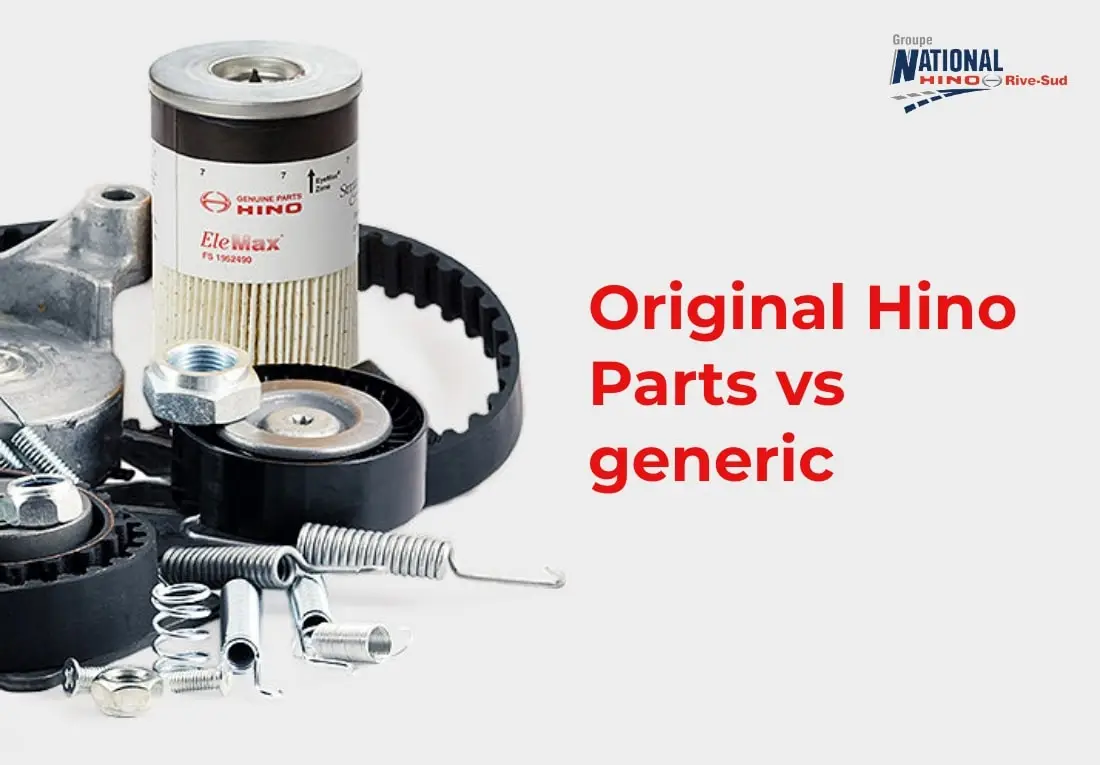
Quick summary: Why choose original Hino parts? Perfect compatibility: designed for your Hino model, without compromise. Preserved warranty: mandatory to maintain manufacturer’s coverage. Performance & reliability: materials tested for Quebec roads. Long-term savings: fewer breakdowns, fewer replacements. Generic parts = increased risks: premature wear, frequent breakdowns, lost warranty. A wise choice to protect your investment and drive with peace of mind. Are you hesitating between original Hino parts and generic parts for the maintenance of your truck? This decisive choice has a direct impact on the performance, reliability and even warranty of your vehicle. Here we explain why opting for official replacement parts can avoid costly glitches, guarantee perfect compatibility and safeguard your investment over the long term. Why choose Hino original parts? When it comes to maintaining your Hino truck, official replacement parts make all the difference. Here’s why: Guaranteed compatibility: tailor-made for each Hino Series model, they perfectly match factory specifications. Premium durability: materials tested in extreme conditions to withstand the most demanding Canadian kilometers Protected warranty: must be used to maintain manufacturer’s coverage on engines and critical systems Optimized performance: perfect synchronization with Hino truck electronics and mechanics Long-term savings: fewer replacements and unexpected breakdowns despite a higher initial investment Hino parts fit into your truck like a puzzle. Designed to the same tolerances as the original components, they avoid haphazard adjustments that erode reliability. This technical precision, the fruit of Toyota’s technological excellence, explains why 9 out of 10 mechanics recommend them for recent Hino models. To make sure you’re using quality components, find out more about certified genuine Hino parts. ” My engine used to fail every 500,000 km. Since fitting Hino filters, I’ve pushed a vehicle to 1 million km with no major problems! “says Martin, a carrier in Alberta. Longevity boosted by filter materials 30% denser than average – the kind of detail that makes all the difference over time. Call us today to find out more. Choosing generic parts is a bit like putting ordinary petrol into a diesel engine. Technically possible, but risky for the manufacturer’s warranty. Hino Canada dealers require official components to honor their 3-year coverage – a safety net worth its weight in gold. Risks and limits of generic parts Recurring technical problems Leaky gaskets, poor calibration… that’s the daily lot with non-official parts. Air brake systems and injectors are the first to suffer. A study of 50 Quebec trucks showed that 60% of repeated failures came from generic injection pumps. Take the example of this fleet of 12 carriers in Montreal. After switching to aftermarket parts, they had to replace 3 pumps in 18 months. The result? $15,000 CAD in unexpected repairs and 200 hours of downtime. Enough to make you think twice before giving in to attractive prices. Low-end materials wear out 40% faster, according to mechanics. You end up having to replace parts twice as often: a costly miscalculation. False savings: the real cost 5-year cost comparison: genuine Hino parts vs. generic parts Criteria Original Hino parts Generic parts Average purchase cost 20-40% higher Attractive initial price Replacement frequency 1x Up to 3x Manufacturer’s warranty 3 years No coverage Total estimated cost 12 000$ CAD 18 500$ CAD Take brakes: generic brakes cost 30% less to replace… but last half as long. Our Total Cost of Ownership study shows that theoriginal clutch retains 70% of its performance after 150,000 km, compared with 45% for copies. A well-maintained Hino truck with official parts sells for 15% more. Pro buyers scrupulously check the history of components – a traceability impossible with non-certified parts. Beware of warranty clauses: 85% of disputes arise from repairs carried out using aftermarket parts. Replacing a faulty turbo can quickly go from $0 to $8,000 CAD if the warranty is breached. Making the right choice for your truck For a recent vehicle under warranty, Hino parts are the obvious choice. But on a 10-year-old truck used occasionally, certain non-critical components can tolerate generics – provided you check their provenance. The trick? Reserve this option for simple wear parts such as air filters, never for vital engine components. Always use Hino Canada-approved suppliers. Check theofficial packaging with serial number and anti-counterfeiting hologram. Our service guide gives you contact details for certified distributors in every province. A good idea: call us today to validate the compatibility of a part before purchasing. Choosing genuine Hino parts means perfect compatibility, increased durability and warranty coverage. Check approved suppliers to avoid unpleasant surprises: every immediate saving often conceals a costly risk. Your truck deserves uncompromising reliability, today and in 500,000 km. Frequently asked questions about Hino original parts (FAQ) How do I install a genuine Hino part correctly? To correctly install a genuine Hino part, it is crucial to consult the repair manual specific to your truck model. This manual provides detailed instructions and diagrams for proper installation. We also recommend having parts installed by a Hino dealer, such as Groupe National Hino Rive-Sud, to benefit from a 3-year warranty on genuine parts. Be sure to follow the installation instructions supplied with the part and use the appropriate tools. Check the compatibility of the part with your Hino truck model before beginning installation. If you’re not sure you can install a part correctly, call in a professional. How can I benefit from discounts on Hino parts? To take advantage of discounts on Hino parts, contact Hino dealers directly and check their websites for current promotions. Some dealers, like Groupe National Hino Rive-Sud, regularly announce advantageous programs. Take advantage of warranties, such as the one offered by Hino Rive-Sud, which offers a one-year warranty on OEM parts purchased at the parts counter and a 3-year warranty if the parts are installed in their dealership. Explore liquidation parts options, such as those offered by Centre du Camion Hino in Boucherville, and compare prices online on sites like Fridayparts. You can also search for used parts on platforms like Kijiji and Autoline Maroc, although it’s important to check their condition

Quick summary: Why the TCO of a Hino truck makes all the difference Up to 40% savings on mechanical costs over 5 years, according to Boucherville customers Ultra-reactive 24/7 service on the South Shore: response in less than 2 hours on the A20 5-year / 500,000 km warranty on engine, gearbox and transmission Predictable maintenance = fewer breakdowns, more time on the road Optimized TCO = more profitability per truck, year after year What if the purchase price of your truck is just the tip of the iceberg? For Canadian carriers, the real cost is in the hidden expenses: fuel, maintenance and downtime. This article reveals how Boucherville’s Hino trucks turn the Hino truck TCO (Total Cost Ownership) into an ally, thanks to their fuel-efficient diesel engines, legendary reliability and after-sales service that limits downtime. Because long-term savings are as simple as choosing the right road partner. Hino Truck TCO: the true calculation of profitability The true cost of a Hino truck goes far beyond its purchase price. Fuel, maintenance, downtime: each element weighs on the TCO. For Canadian carriers, this equation is solved by reliability and responsive after-sales service. Beyond the purchase price, here are the black holes that will eat into your budget over 10 years: Unplanned downtime: every hour of downtime costs thousands in lost revenue Accelerated depreciation: an unreliable model loses value up to 30% faster Inflated insurance: premiums soar with frequent claims Wasted fuel: an ageing engine drinks 15% more after 5 years Corrective maintenance: urgent repairs cost 50% more than scheduled maintenance Compared with a standard model, the Hino 195 pays for itself in 5 years, thanks to 40% lower mechanical costs and optimized fuel consumption. Unlike other, less reliable brands, every year of use reinforces its economic advantage – as Boucherville’s fleets testify. Engine and maintenance: Cummins’ secrets to profitability Under the hood of Hino’s L and XL series trucks, Cummins B6.7 and L9 engines aren’t there for show. Designed to endure the Canadian climate and Quebec roads, these diesel blocks combine performance and low operating costs, thanks to intelligent engine speed management, simplified architecture and high-quality components. The result? Less maintenance, higher availability, and optimized TCO from the very first year. Here is a table comparing the advantages of the engines fitted in Hino trucks with the market average: Maintenance type Cummins B6.7 / L9 Market average Engine oil change Up to 80,000 km (with oil analysis) 15,000 – 20,000 km Particulate filter (DPF) Cleaning at 400,000 km 150,000 – 250,000 km Complete brake overhaul 120,000 km 30,000 – 50,000 km Coolant replacement 500,000 km or 5 years 200,000 – 300,000 km or 2-3 years Accessory belt Up to 240,000 km 60,000 – 160,000 km To remember:Cummins B6.7 and L9 engines mean less heavy maintenance, less unplanned downtime and longer life for key components. For a fleet of 5 trucks, this can represent thousands of dollars saved over 3 to 5 years, in maintenance alone. Like this Boucherville-based carrier, who has seen his mechanical costs drop by 40% in 5 years: “With Groupe National Hino Rive-Sud, maintenance becomes a formality, not a surprise”. By applying the recommended good maintenance practices, his annual savings are equivalent to the salary of an extra driver. The inherent robustness of Hino trucks means fewer visits to the workshop, while keeping costs under control. Warranties and services: the invisible levers of your TCO The Canadian Hino network: 24-hour support that counts The Hino Rive-Sud center in Boucherville responds in less than 2 hours on the A20, with 12 certified technicians available at all times. As in the case of this semi-trailer taken in charge at -25°C last January: express diagnosis, parts in stock and back on the road in just 8 hours. This rapid response limits the financial impact of unforeseen breakdowns on TCO. An “anti-bad surprise” guarantee policy Hino powertrains are covered for 5 years/500,000 km – including engine, gearbox and transmission. All-risk insurance for your maintenance budget. Even on certified pre-owned vehicles, the warranty is fully transferable after full inspection. Contact us today to find out more about the 78 checkpoints that guarantee optimized TCO over the long term. Choosing a Hino truck means relying on a controlled total cost of ownership: optimized fuel, reduced maintenance thanks to proven reliability, and limited downtime thanks to responsive after-sales service in Boucherville. For sustainable savings, the equation is clear – every day without Hino is money down the drain. Tomorrow is already moving at the pace of profitability. Frequently asked questions about Total Cost of Ownership of a Hino truck (FAQ) How much does a used Hino truck cost? The price of a used Hino truck fluctuates according to several determining factors, such as the model, year of manufacture, mileage and general condition of the vehicle. For an accurate estimate, call us today at (450) 641-1115 Does the Hino truck belong to Toyota? Yes, Hino Motors is a subsidiary of the Toyota Group. More specifically, Hino Motors Canada, Ltd. is a wholly-owned subsidiary of Hino Motors Ltd (HML) and an integral part of the Hino Group. In 2001, Toyota Motor Corporation acquired a majority stake in Hino Motors, Ltd. thus strengthening the ties between the two companies. This acquisition solidified Hino’s position as a key member of the Toyota group, while enabling it to benefit from the resources and expertise of one of the world’s largest automakers. What are the advantages of the Hino 195? The Hino 195 stands out for its reliability and durability, essential assets for professionals. It’s designed to transport your team and equipment in total peace of mind, while offering optimum comfort. This model is equipped with a 5-liter Hino J05E-TP turbo diesel engine, renowned for its efficiency and performance. What’s more, buyers of a new Hino truck benefit from three years’ free roadside assistance, a significant advantage for added peace of mind. What are the main advantages of choosing a Hino truck in terms of TCO (total cost of ownership)? Choosing
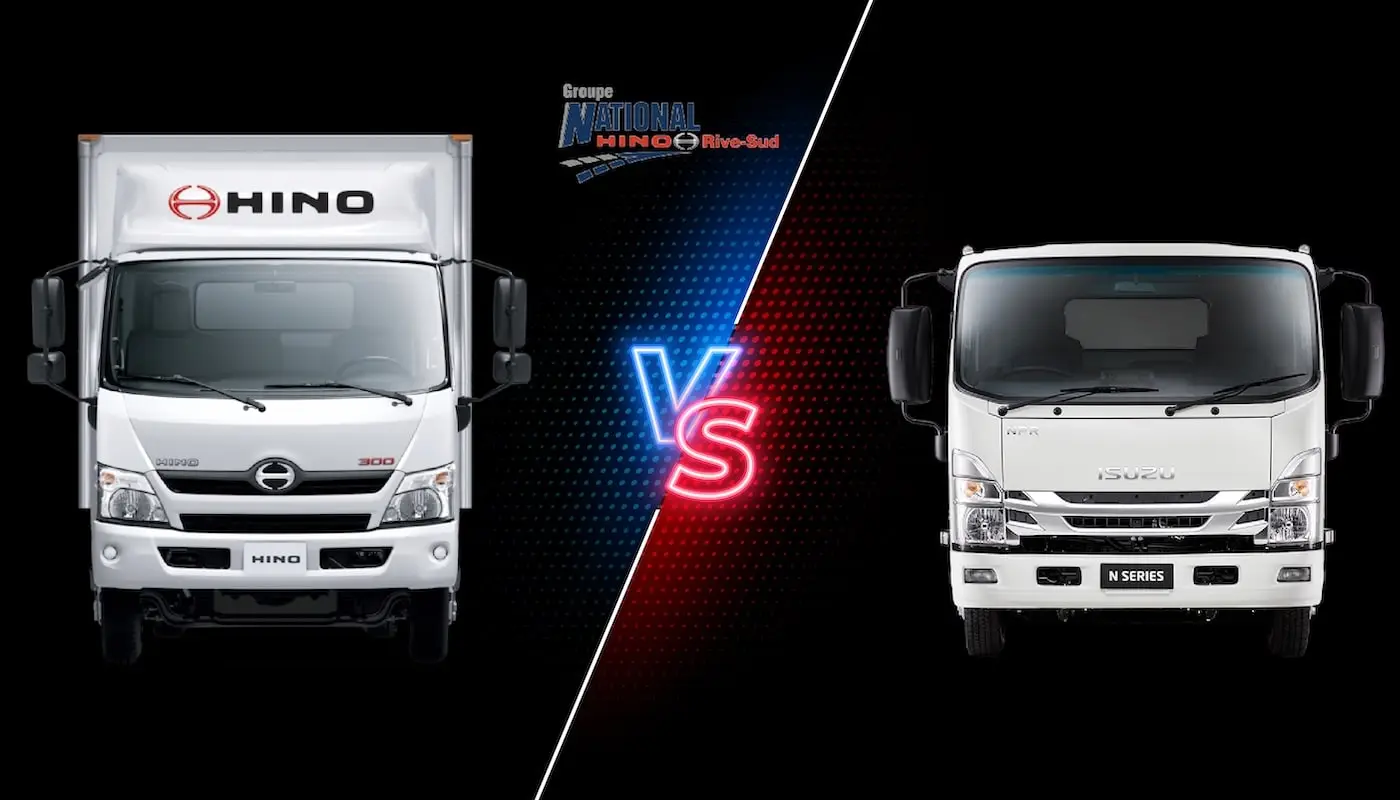
Quick summary: Hino vs Isuzu truck Stronger chassis: Hino offers 33% greater bending strength than Isuzu Extended warranty: 5 years/unlimited on Allison transmissions, 3 years on parts 24/7 service: Mobile units and South Shore Hino workshop open until midnight Optimized fuel consumption: up to 10.9% fuel savings Driving comfort: Ergonomic cab, air conditioning and cruise control as standard Winter reliability: Intelligent transmission for Quebec roads Local support: Service, parts and financing directly in Boucherville Criteria Hino Isuzu Frame High-strength steel 56,900 PSI (+33%) 44,000 PSI steel RBM (bending strength) 422,900 in.-lb (Hino 195) Approx. 317,000 in.-lb (NRR) Transmission warranty 5 years / unlimited mileage (Allison) Not specified Service program Elite Master technicians + proactive planning Less centralized network Roadside assistance 24/7 – Mobile units + workshop until midnight Less regional availability Standard equipment Air conditioning + regulator included Often optional Fuel consumption Up to 10.9% lower than average Higher depending on conditions Quebec dealer network Large network (including Hino Rive-Sud in Boucherville) More limited by region Choosing between a Hino and an Isuzu truck for your fleet is a bit like wondering which key piece to add to your team: the decision weighs heavily on productivity. In this comparison of mid-size trucks in Canada, we take apart the decisive advantages engine by engine – from the armored chassis to the maintenance programs that protect your budget. You’ll discover why local professionals choose the Hino Rive-Sud network when it comes to robustness and 24/7 service. Comparative robustness and durability When you compare Hino vs Isuzu, you’re not comparing kiwis and pineapples. Canadian SMEs are looking for solidity: high-strength steel, engines built for the cold and transmissions that hold up. The Hino chassis, boosted by 56,900 PSI alloys, handles potholes better than its competitor. To assess the durability of intermediate trucks, five technical criteria make the difference: Reinforced chassis with high-strength steel (56,900 PSI at Hino vs. 44,000 PSI at Hino) Diesel engine optimized for Canadian thermal amplitudes Allison transmission with integrated corrosion protection Extended 5-year/unlimited warranty on 2020+ models Fuel consumption 10.9% lower than the competition Take the Hino 195, medium-weight champion. Its chassis is 33% more resistant to bending than the Isuzu NRR, with an RBM of 422,900 in.-lb. The icing on the cake: air conditioning and regulator included as standard, unlike many competing models. Enough to transport your heavy equipment without sweating oil – literally. Overall cost and technical support Key comparison between Hino and Isuzu for Canadian fleet managers Criteria Hino Isuzu Parts and service warranty 3 years/unlimited km with original parts + 5 years on Allison transmissions Information not specified Service availability 50+ dealers, 24/7 assistance and repair center open until midnight Less dense network in Canada Spare parts Original Hino with 3-year warranty, Elite Master certified technicians Multiple suppliers with no single certification Hino Canada’s Premium Quality Protection program means peace of mind. Elite Master-certified technicians plan your overhauls like an orchestra conductor – with zero unpleasant surprises. These good maintenance practices, coupled with a 3-year warranty on repairs, lower your bill over 5 years. At Groupe Nationale Hino in Boucherville, we never leave you in the lurch. Six workshop trucks are on the road 24 hours a day to repair your fleet, even at -30°C. Their technical center is open until midnight on weekdays – ideal for SMEs running at full speed. Call us today for your next Hino truck and try out this service with a difference. Informed driving and decision-making Inside a Hino, there’s no compromise on comfort. Ergonomic seats, comfort, integrated cruise control and air conditioning that holds its own even at -25°C. Fatigue detection systems discreetly monitor your driving – a real virtual co-pilot for long distances. When it comes to snow, Allison transmissions show their expertise. Their electronic management system adjusts traction second by second, even on black ice. No need to become a winter driver: the truck adapts itself to the vagaries of Canadian weather. Seven good reasons to choose Hino : 24/7 road service with dedicated mobile units Intelligent Allison transmission for extreme winter conditions Original parts available within 24 hours from Groupe Nationale Hino Ergonomic cab with cruise control and air conditioning as standard Flexible financing programs through Toyota Commercial Finance At Hino Rive-Sud, we take the administrative headache out of the equation. One phone call is all it takes to get a personalized test drive or a customized financing offer. Because the right choice of truck is made behind the wheel – not behind a screen. In the face of Canadian challenges, Hino stands out with its reinforced chassis, economical maintenance program and 24/7 service at Groupe Nationale Hino Rive-Sud in Boucherville. For a truck that combines ruggedness with long-term peace of mind, contact Hino Rive-Sud today. Your business deserves a partner who drives as hard as you do. Frequently asked questions about Hino vs Isuzu trucks (FAQ) What’s the difference between Hino and Isuzu? Criteria Hino Isuzu Frame High-strength steel 56,900 PSI (+33%) 44,000 PSI steel RBM (bending strength) 422,900 in.-lb (Hino 195) Approx. 317,000 in.-lb (NRR) Transmission warranty 5 years / unlimited mileage (Allison) Not specified Service program Elite Master technicians + proactive planning Less centralized network Roadside assistance 24/7 – Mobile units + workshop until midnight Less regional availability Standard equipment Air conditioning + regulator included Often optional Fuel consumption Up to 10.9% lower than average Higher depending on conditions Quebec dealer network Large network (including Hino Rive-Sud in Boucherville) More limited by region What’s the most reliable brand of truck? Hino and Isuzu are both renowned for their reliability. Hino is renowned for its longevity, thanks in particular to its Cummins B6.7 engine, whileIsuzu is appreciated for the robustness of its N series models. Both brands are considered popular choices for businesses. The choice between Hino and Isuzu will depend on your specific needs, such as the type of goods to be transported and your budget. It’s important to evaluate these factors carefully before making your final decision. What Hino financing
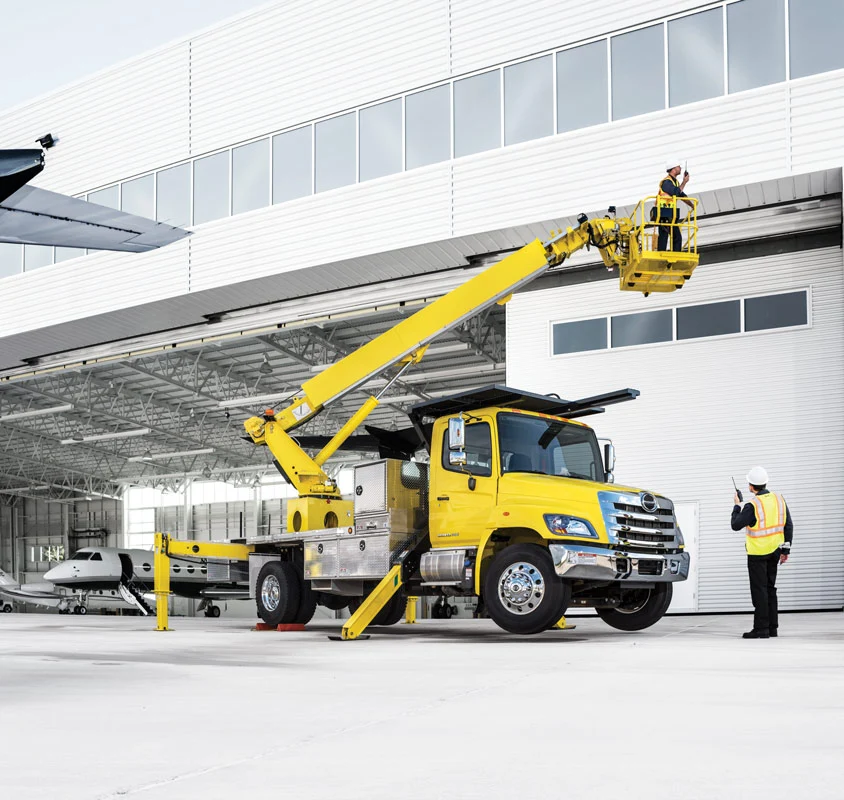
🔧 Quick summary: Buy vs Rent Hino truck for SMBs in Quebec Purchase = higher initial investment ($50,000 to $60,000) but long-term profitability and advantageous resale Rental = lower monthly payments (up to -30%), ideal for seasonal needs or financial flexibility 5 criteria to analyze: monthly budget, length of use, debt ratio, available subsidies, hidden costs Assistance available: Écocamionnage, Roulez vert grants, tax credits (up to $9,000 in savings) SME tip: mix purchase + rental = optimized fleet, reduced risks, better tax deductions Wondering whether to buy or lease a Hino truck for your South Shore SME? Between unexpected maintenance costs and tight budgets, choosing the right option becomes a headache. This guide compares buying and leasing Hino trucks in Canada, with concrete cash flow figures and local feedback. Find out why owning your own truck could boost your profitability, even in the face of Quebec’s logistical challenges. Financial analysis for South Shore SMEs On Montreal’s South Shore, carriers are juggling US tariffs and adapting to the new transportation network. With REM shaking things up and margins melting like snow in the sun, every decision counts. To make an informed decision, evaluate these five important aspects: Actual monthly budget: Calculate your leeway by comparing your cash inflows and outflows (a Hino 195 requires 15-20% of sales in transport). Horizon of use: Determine whether your need is occasional (3-5 years) or permanent – models like the Hino L7 are more valuable on resale. Debt ratio: Check your ability to absorb a 60-month loan without affecting your working capital (recommended threshold: <30% of sales). Accessible subsidies: Explore Quebec programs like Écocamionnage and Roulez vert that can cover up to 25% of the cost of an electric XL8. Hidden costs: Allow 6-10% of the annual purchase price for maintenance – tires on a Hino L6 cost 20% less with an inclusive rental. Buying a Hino 195 requires an initial outlay of $50,000 to $60,000 including taxes, compared with an average of $3,000 for a lease. But beware: Hino financing programs often make all the difference, especially with advantageous rates for local SMEs. Take Transports Lemieux in Longueuil: by buying its Hino 195 rather than leasing it, the company saved 18% over 3 years, despite the off-peak seasons. The secret? Negotiated maintenance with Hino Rive-Sud, smoothing out expenses over the year. Advantages and disadvantages by option Buying: a tailor-made investment 5-year cost comparison for Hino trucks in Canada Model Financial characteristics Impact on total cost Hino 195 Initial investment of $50,000 to $60,000 (used)Maintenance: 6-10% of annual cost5-year engine warranty Transferable warranty preserves resale valuePredictable maintenance costs Hino L6 Flexible financing via Toyota Commercial FinanceAvailable Hino protection programsEligible Quebec subsidies Controlled depreciationTax credits up to $4,000Fixed monthly costs Hino L7 Improved load capacityMaintenance included 1 year/50,000 kmHinoWatch 24/7 support Increased ROI through productivityReduced downtimeTax optimization Hino XL8 Certified energy efficiencyEligible for ÉcocamionnageGo Green bonus up to $5,000 Fuel savings up to 15%Advantageous tax deductionsReduced depreciation Personalizing your Hino is like choosing a tailor-made suit: corporate paintwork, ergonomic cab layout or engine reprogramming. But beware of warranties – it’s better to go through authorized professionals like Hino Rive-Sud to keep your rights intact. Quebec SMEs can accumulate up to $9,000 in assistance with Ecocamionnage grants and Hino Canada rates. A significant boost when you consider that unexpected maintenance on an L6 can eat up 15% of your annual budget. The key? Allow 8-12% of the purchase price in hidden costs. But with the good maintenance reflexes keep your cash flow under control. Leasing: strategic flexibility Hino leasing contracts are generally for 36 to 60 months, with monthly payments 30% lower than a conventional loan. The trick: negotiate the mileage included and the return clauses to avoid unpleasant surprises. The all-inclusive packages are worth the detour: tires, oil changes, 24-hour assistance and even vehicle replacement in the event of a major breakdown. Perfect for Saint-Hubert transporters juggling seasonal peaks. Take the example of an eco-responsible delivery company: by renting electric XL8s via the Roulez vert programs, it boosted its image without breaking the bank. The result: 40% more requests for public contracts in 18 months. Impact on cash flow and corporate strategy For a small business on the South Shore, devoting more than 20% of sales to transport can become stifling. Renting allows you to smooth out expenses, while buying a Hino L6 offers an immediate tax deduction – provided you’re strong enough. Mixing purchasing and leasing is like putting together an economic menu: owning 2 Hino 195s for regular journeys, and leasing an electric XL8 for seasonal peaks. This hybrid approach reduces debt while maintaining a modern fleet. Our analysis of Hino fleet strategies shows an average gain of 12% on annual cash flow. “After 5 years managing 15 trucks in Brossard, the real trap is to underestimate maintenance,” confides Marc D. One of his Hino L7s lost 40% of its value in 3 years due to a lack of preventive maintenance. His advice?“Always negotiate warranties with your Groupe National Hino Rive-Sud dealer – it saves thousands in the event of a glitch.” Opting to buy a Hino truck maximizes your long-term cash flow, while leasing offers immediate flexibility. By combining the two, Canadian SMEs can adapt their fleets without complicating their lives. Check out Hino Canada’s financing programs today: your next vehicle could well seal the future of your operations. Frequently asked questions Buy vs. Rent Hino Truck (FAQ) Is Hino a reliable brand? Hino is widely recognized for its reliability and durability in the truck sector, making it a popular choice for businesses. This reputation is supported by the use of Cummins engines on certain models, contributing to robust performance. However, it is important to note that Hino has faced scandals linked to irregularities in engine testing, which have affected its credibility. Despite these incidents, its membership of the Toyota group remains a guarantee of quality for many customers. Who makes Hino trucks? Hino trucks are manufactured by Hino Motors, Ltd, a

🔧 Quick summary : Hino warranty for trucks in Canada Hino basic warranty: covers manufacturing defects on essential components such as the motor and transmission. Period of protection: varies according to model; often several years with high mileage. Extensions available: choose between full coverage, powertrain or specific parts according to your needs. Conditional validity: servicing must be carried out by an authorized Hino dealer using genuine Hino parts. Anti-pollution systems: sometimes benefit from extended coverage in line with environmental standards. Protect your investment: a well-maintained warranty = substantial savings on major repairs. Buying a Hino truck represents an investment in your business, but what happens when mechanical problems arise? The Hino warranty offers first-rate protection covering several essential components such as the engine and transmission, ensuring owners’ peace of mind. In this article, we reveal the full details of the extent of this warranty in Canada, and the steps required to take full advantage of it. Standard Hino warranty coverage The warranty offered by Hino Canada represents a solid safety net for truck owners. It covers defects in workmanship and materials, saving you unexpected expenses during your first years of use. In terms of precise coverage, Hino’s basic warranty covers important components such as the engine and transmission, the pillars of your vehicle’s reliability. Other important mechanical components are also covered, while the duration of coverage varies according to model and year of manufacture. Anti-pollution systems sometimes have additional coverage to comply with environmental regulations. Guaranteed duration of coverage (estimates) Component Duration (estimated) Remarks Engine Many years / High mileage Varies according to model and year Transmission Many years / High mileage Varies according to model and year Other essential mechanical parts 1 to 2 years / Specific mileage Varies according to model and year Anti-pollution system Variable Additional coverage available Extended warranties available Extending the protection of your Hino truck beyond the initial period is now possible thanks to the various extension options offered by Hino Canada. Here is an overview of the extended warranty options offered by Hino Canada: Extension Complète: Extended coverage for total peace of mind. Powertrain: Protects essential components such as the engine and transmission. Specific components: Target protection to critical parts. Investing in a Hino extended warranty saves you a lot of financial headaches when costly repairs are needed after the basic warranty has expired. The additional protection usually covers the same items as the original warranty but over an extended period, offering additional security for your commercial vehicle. Extensions can be tailored to your specific needs and the use you make of your truck. You can opt for standard coverage, or choose customized options for certain parts that are in greater demand in your business. Contact us today to explore the various extended warranty packages available for your Hino truck model. How to keep your warranty valid A regular maintenance carried out in accordance with the manufacturer’s recommendations, is crucial to maintaining the validity of your Hino warranty. Here are a few best practices to keep your Hino warranty valid: Follow Hino’s recommended maintenance schedule. Keep all receipts and proof of maintenance. All servicing and maintenance should be carried out by an authorized Hino dealer. Entrust the maintenance and repair of your Hino truck to an authorized Hino dealer to guarantee compliance with the manufacturer’s standards. Hino-trained technicians are fully conversant with your vehicle’s specifications and have the right tools at their disposal. The use of non-compliant parts may impair your truck’s performance and even void your warranty protection. For optimum protection, always use genuine Hino parts. Comparison of original Hino parts vs. alternative parts Features Original Hino parts Alternative parts Warranty Maintaining the Hino warranty May void Hino warranty Quality Designed to Hino standards Variable quality Reliability Optimum performance May affect performance The use of genuine Hino parts is strongly recommended to ensure truck performance and reliability. Contact us today at 450-641-1115 to schedule your next service and keep your warranty valid. Taking care of your Hino truck with regular maintenance at an authorized dealer not only protects your investment, but also preserves the validity of your warranty. The use of genuine Hino parts ensures optimum performance and extended life for your vehicle. Given the cost of major repairs, keeping your warranty coverage active is undoubtedly the best economic decision for any Hino truck owner. Frequently asked questions about the Hino Canada warranty (FAQ) What does the Hino basic warranty cover? The Hino Basic Warranty offers protection against defects in workmanship and materials, covering essential components such as the engine and transmission. This warranty gives you peace of mind by avoiding unexpected expenses during the first years of your truck’s life. The duration of coverage varies according to vehicle model and year of manufacture. In addition, emission control systems may benefit from additional coverage to comply with environmental regulations. What extended warranties are available for my Hino truck? Hino Canada offers various warranty extension options to extend your truck’s protection beyond the initial period. These includeFull Extension for extended coverage, Powertrain targeting the engine and transmission, and options for Specific Components. Investing in a Hino warranty extension protects you against the cost of unexpected repairs after the basic warranty has expired. These extensions can be tailored to your specific needs and truck usage, giving you added financial security. How do I keep my Hino warranty valid? To preserve the validity of your Hino warranty, it is crucial to carry out regular maintenance in accordance with the manufacturer’s recommendations. Strictly follow the maintenance schedule, keep all receipts and proof of maintenance, and carry out repairs and maintenance at an authorized Hino dealer. Entrusting your truck to an authorized Hino dealer guarantees compliance with the manufacturer’s standards and the use of genuine Hino parts. The use of non-conforming parts can alter the performance of your truck and even void your warranty. Are Hino engines made by Toyota? No longer, today, the engines of the new Hino L6, Hino L7, Hino L8 and Hino

🔧 Quick summary: 10 essential preventive maintenance checks for your Hino truck Before you hit the road again, make sure your Hino truck is in top condition with this monthly maintenance checklist: Engine oil level: optimum lubrication to prevent overheating. Coolant: maintains ideal engine temperature. Brake fluid: guarantees safe braking response. Brake wear: pads and discs in good condition for efficient stopping. Tire pressure: safety, stability and fuel economy. Tire condition: tread depth and absence of damage. Lighting: all lights functional to SAAQ standards. Windshield wipers: clear visibility in all seasons. Battery: reliable starting and constant power supply. Steering system: smooth, trouble-free handling. Is your Hino truck really ready to get back on the road safely? Regular, methodical Hino truck maintenance is important to avoid costly breakdowns and ensure your vehicle meets the safety standards required by the SAAQ. Our preventive Hino truck maintenance checklist guides you through the 10 crucial points to check, from fluid levels to brake condition, to extend the life of your investment and ensure worry-free journeys. Engine oil level Checking the oil level in your Hino truck is an important preventive maintenance operation. Proper lubrication reduces friction between the engine’s moving parts. An optimal oil level also helps dissipate the heat generated by the engine, preventing the risk of overheating that could damage your vehicle. To check your truck’s oil correctly, park on a flat surface and wait for the engine to cool down. Then remove the dipstick, wipe it with a clean cloth and reinsert it completely. If you look again, the level should be between the minimum and maximum marks. If you notice a rapid drop or blue smoke from the exhaust, contact our specialized technicians. Hino trucks are renowned for their reliability and robustness, but regular maintenance is essential to maintain these qualities. Coolant (coolant specifications for Hino models) Hino model Engine type Recommended fluid type Approximate quantity Replacement interval Hino 155 5.1 L – 4-cylinder diesel Long Life Coolant (pink or red, OAT) ~12 liters Every 240,000 km or 4 years Hino 195 5.1 L – 4-cylinder diesel Organic-based LLC (silicate-free) ~12 liters Every 240,000 km or 4 years Hino L6 8.9 L (Cummins L9) Extended Life Coolant (ELC) (red) ~28 to 30 liters Every 320,000 km or 5 years Hino L7 8.9 L (Cummins L9) ELC to ASTM D6210 (OAT-based) ~28 to 30 liters Every 320,000 km or 5 years Hino L8 8.9 L (Cummins L9) Long-life coolant (nitrite/silicate-free) ~28 to 30 liters Every 320,000 km or 5 years Hino XL8 8.9 L (Cummins L9) Fleetguard ELC (red, silicate-free OAT) ~28 to 35 liters Every 400,000 km or 4 to 5 years Coolant plays an important role in the durability of your Hino truck’s engine. It dissipates the excessive heat produced by the engine and maintains an optimum temperature for efficient combustion. Quality coolant also protects components from corrosion and prevents freezing in cold weather. Checking this level is an essential part of preventive care for any driver who cares about his vehicle. To check the cooling level correctly, wait until the engine is cold to avoid pressure and heat burns. Examine the transparent reservoir and check that the level is between the “MIN” and “MAX” marks. If the level is low, add the appropriate fluid for your model of Hino truck. Take this opportunity to visually inspect the radiator and hoses for leaks. Brake fluid When it comes to safety on a Hino truck, brake fluid plays an important role in the braking system’s performance. This hydraulic fluid transmits the force applied to the pedal to the wheel brakes, ensuring effective stopping of your vehicle even under full load. Insufficient levels or contamination of this fluid can seriously compromise your braking ability, increasing stopping distances and endangering all road users. To check the brake fluid level in your Hino truck, first locate the translucent reservoir near the master cylinder under the hood. Make sure the level is between the “MIN” and “MAX” marks on the reservoir. Before opening the cap, clean the area thoroughly to avoid contamination. If you need to add fluid, use only the type recommended by the manufacturer for your specific model. Rapid drop in brake fluid level. Spongy or sinking brake pedal. Unusual braking noises. Vibrations or pulsations in the brake pedal. These regular checks contribute to the safety of your Hino truck. Special attention to preventive brake maintenance will save you a lot of trouble on the road. A monthly brake fluid check is a simple but important step in keeping your truck up to SAAQ safety standards. This routine inspection, applicable to both fleets and individual trucks, ensures that your Hino remains a safe and reliable working tool. Call us today at 450-641-1115 for more information on our specialized maintenance services. Brake wear Regular inspection of the brakes on your Hino truck is a cornerstone of road safety. A monthly check can detect problems at an early stage and prevent braking distances from increasing dangerously. This practice also ensures compliance with the SAAQ‘s strict standards, saving you from fines or having your vehicle taken out of service during inspections. L’SAAQ truck mechanical inspection is a crucial step in ensuring your Hino’s compliance. To identify excessive brake wear, examine the thickness of the brake pads through the rims or after partial disassembly. There should be no deep scratches or visible cracks. According to the manufacturer’s recommendations, the brake pads on a Hino truck generally need replacing every 40,000 to 60,000 kilometers, depending on your driving style and type of load. Note that driving in the mountains or with heavy loads accelerates wear. Tire pressure The correct tire pressure on your Hino truck plays a vital role in road safety. Correctly inflated tires improve handling and stability, especially during emergency braking or in adverse weather conditions. Optimum tire pressure also extends tire life by reducing irregular wear, while reducing the risk of blowouts during your journeys. Regular preventive maintenance of your tires also helps

🔧 Quick summary: 6 reasons to add a Hino truck to your fleet? Proven reliability: fewer breakdowns, greater productivity on the road Controlled maintenance costs: durable original parts and accessible service Optimized fuel consumption: efficient, economical diesel engines Excellent warranty: up to 5 years’ full protection Hino Rive-Sud local support: certified technicians and parts always available Fast road service: 24/7 assistance to minimize downtime In this article you’ll discover 6 reasons to add a Hino truck into your corporate fleet. Managing a fleet of trucks that breaks down at the wrong time can turn your days into operational nightmares. Integrating Hino trucks into your fleet represents a reliable solution , thanks to their robust diesel engines, optimized fuel consumption and renowned after-sales service. From legendary reliability to exceptional technical support from Hino’s South Shore dealer, discover why these trucks are becoming the preferred choice of fleet managers looking to cut maintenance costs while maximizing productivity. Proven reliability reduces downtime The reliability of Hino trucks far exceeds the standards of the heavy-duty market. Their red engine has become legendary in the industry since the brand became Japan’s market leader in 1973. The giant Toyota, which owns over 50% of Hino, contributes its expertise in quality. Every day that a truck is out of action represents a loss to your business. Hino vehicles minimize these costly interruptions thanks to their robust design, which extends the intervals between breakdowns. This reliability translates directly into transport optimization and a substantial reduction in operating costs. Comparison of Hino L6, L7 and L8 models Model GVWR (lb) Motor L6 25 500 Cummins B6.7 (240 HP) L7 33 000 Cummins B6.7 (260 HP) L8 35 500 Cummins B6.7 (260 HP) This table illustrates the technical features that contribute to the robustness of the various Hino L-series models available for your fleet. Competitive maintenance costs Managing a fleet of trucks represents a substantial investment for any company. Hino trucks stand out for their particularly competitive maintenance costs, which lighten the operational budget. Regular maintenance of these vehicles generally costs between $6,000 and $13,000 a year, including scheduled repairs. Several technical factors contribute to this appreciable saving. The diesel engine of Hino trucks is designed to minimize servicing thanks to extended maintenance intervals. The superior quality of the parts used in the manufacture of the cabs and chassis also reduces the frequency of replacements. Genuine Hino parts help reduce costs. Quality: precision-engineered for reliable performance. Durability: They offer exceptional durability, even under demanding conditions. Adaptability: 100% adapted to Hino trucks. The use of genuine Hino parts ensures optimum maintenance. Efficient consumption The optimized fuel consumption of Hino trucks represents a major financial asset for any commercial or municipal fleet. Their diesel engines, designed to maximize fuel efficiency, significantly reduce fuel costs. For a fleet of ten vehicles, the savings can represent several thousand dollars a year, a benefit that weighs heavily in the balance when renewing a fleet. The engines powering Hino trucks derive their efficiency from advanced technologies. The J series offers excellent fuel economy even under maximum load, thanks to its common-rail direct injection system. In addition, the perfectly calibrated Allison transmission contributes to this performance by adapting gears to driving conditions. This technical combination naturally reduces fuel consumption without sacrificing power. Cummins engine specifications (Hino Series L and XL) Motor Power (HP) Torque (lb-ft) Cummins B6.7 (Hino L6, Hino L7, Hino L8) 240 – 260 560 – 660 Cummins L9 (Hino XL8) 300 – 360 up to 1,150 Caption: Table detailing the power and torque of Cummins engines used in the Hino L and XL series. Excellent warranty When you invest in a Hino truck, you benefit from a really solid warranty that covers the vehicle’s major components. In particular, the standard warranty protects the frame rails and crossmembers for 60 months with no mileage limit, a substantial advantage for fleets that accumulate mileage quickly. Hino also offers peace-of-mind protection against corrosion perforation for the cab. This exceptional coverage represents a real financial shield for companies operating a fleet. By reducing unforeseen expenses associated with major repairs, it enables more accurate budget planning and lowers the total cost of ownership. As a result, managers can concentrate on their day-to-day operations without fear of the unpleasant surprises that could result from a costly engine or transmission failure. Coverage: Includes HINOWATCH roadside assistance for the first 3 years. Engine: The 5.1-liter J05E engine is covered by a 5-year/280,000 km warranty. Chassis: Chassis side members and crossmembers are covered for 60 months. This Hino warranty gives you peace of mind and increased resale value. Given the quality of this protection, don’t hesitate to explore the options that best suit your operational needs. Call us today for warranty details on the models you’re interested in. Hino Rive-Sud dealer technical support Hino Rive-Sud puts a team of certified technicians at your disposal to keep your fleet running smoothly. This specialized technical service intervenes quickly to minimize downtime for your trucks. The permanent availability of genuine Hino parts and their express delivery are a major asset for commercial fleet managers. Since the performance of your fleet depends directly on the expertise that accompanies it, Hino Rive-Sud invests heavily in the training of its mechanics. These professionals master the technical specifications of L6, L7 and L8 models, as well as their particular applications. Call us today for information on our preventive maintenance programs to extend the life of your vehicles. Fast road service in case of breakdown The Hino roadside service stands out for its rapid response when a truck encounters a problem on the road. Accessible 24 hours a day, this assistance system enables drivers to immediately contact specialized agents via a simple emergency button integrated into the vehicle. These professionals can then send the necessary help directly to the truck’s location, without wasting any time. When a transporter breaks down at the roadside, every minute counts for business. Hino’s roadside assistance service minimizes this downtime with rapid interventions to start