
End of content

Menu
Contact your Hino dealer
Hino Rive-Sud National Group
Hino L-Series: L6, L7 or L8 – The ideal truck for your deliveries and services on the South Shore of Montreal

In a nutshell
The Hino L-Series brings together three medium-duty trucks. The Hino L6, Hino L7 and Hino L8 are designed for commercial fleets that work hard every day. The Cummins B6.7 engine, Allison automatic transmission and advanced cab with 55° turning circle: a solid common base, available in three capacity levels to suit your exact needs. The essentials at a glance.
| Question | Quick answer |
|---|---|
|
🚛
Which models make up the L Series? The complete range in a nutshell. |
Three models: L6 (class 6), L7 (class 7) and L8 (class 7+), covering from ~25,950 lb to ~35,000 lb GVWR.
|
|
⚙️
Which engine powers the L Series? The engine common to all three models. |
The 6-cylinder Cummins B6.7, up to 260 HP and 660 lb-ft of torque, with exhaust brake and warranty up to 5 years / 480,000 km.
|
|
🔄
Which transmission is standard? Allison 6-speed automatic on all models. |
Allison 2200 RDS on L6
Allison 2500 RDS on L7 Allison 3000 RDS on L8 5-year/unlimited km warranty. |
|
🏗️
Which chassis resistor? The truck's backbone. |
80,000 PSI for L6 and L7
120,000 PSI for L8 (+50% structural strength). |
|
🔀
Why ideal in an urban environment? The maneuverability advantage of the advanced cab. |
55° turning angle, easy U-turns, tight dock access and simplified manoeuvring in South Shore shopping areas.
|
|
💰
What are the real operating costs? TCO calculated over 60,000 km/year - 5 years - after resale. |
L6: ~$1.01/km (~$60,310/year)
L7: ~$1.05/km (~$62,788/year) L8: ~$1.07/km (~$64,082/year) Difference L6→L8: only $0.06/km. |
|
❓
Which model to choose? The simple rule for quick decisions. |
L6 → delivery and service
L7 → heavy loads and platforms L8 → bulk, tippers and heavy-duty towing Not sure? Contact Hino Rive-Sud (450)-641-1115. |
Serie L in figures
One engine, three chassis, three Allison transmissions and one of the most competitive TCOs in the medium-duty segment in Quebec. L6, L7 or L8: at Hino Rive-Sud in Boucherville, our team can analyze your actual usage and recommend the right model, the right wheelbase and the most cost-effective options for your fleet.
1. Introduction: the real challenges facing fleets on the South Shore
Every working day on Montreal’s South Shore puts your trucks to the test. Tight driveways, congested industrial parks, busy streets in Boucherville, Longueuil or Varennes, repeated loading and unloading, mixed routes between commercial zones and busy arteries – this is the daily reality for your drivers and your vehicles. In this context, the choice of a medium-duty truck is not a trivial decision. It has to be robust, maneuverable, comfortable, reliable over the long term and easy to maintain.
The Hino L-Series, comprising the L6, L7 and L8 models , has been designed precisely for this type of work. It combines a proven powertrain (Cummins B6.7 + Allison 6-speed), a heavy-duty chassis adapted to the level of use of each model, and a cab designed for the daily comfort of operators.
As a specialized dealer on the South Shore, Hino Rive-Sud is with you every step of the way: from choosing the right model to maintenance, repair, parts and regulatory inspections.
2. Overview: Hino L6, L7 and L8
Hino’s L-Series covers a GVWR range from around 25,500 lb to 35,000 lb, positioning it firmly in classes 6 and 7. Three models make up this family:
The L6: a versatile entry-level model for delivery and service.
The L7: the heavy-duty all-rounder, for heavier loads and more demanding bodywork.
The L8: the strongest member of the family, for intensive use and the toughest applications.
Despite their different capacities, all three models share the same design philosophy: a forward cabin with maximum visibility, a standardized powertrain (Cummins B6.7 + Allison 6-speed) and a high-strength steel chassis designed for North American bodies.
Hino L6, L7 and L8: comparative data sheet
Compare the three L-Series models side by side: GVWR, axles, engine, transmission, chassis, wheelbases and target applications.
| Features | Hino L6 | Hino L7 | Hino L8 |
|---|---|---|---|
|
🏷️
Weight class North American regulatory classification |
Class 6 |
Class 7 |
Class 8 |
|
⚖️
GVWR (lb) Gross vehicle weight |
~25,500-25,950 lbs |
~33,000 lb |
~35,000 lb |
|
🔩
Front axle (lb) Front axle load capacity |
10,000 lb |
12,000 lb |
14,000 lb |
|
🔩
Rear axle (lb) Rear axle load capacity |
19,000-21,000 lb |
21,000 lb |
23,000 lb |
|
⚙️
Engine Engine common to the entire range |
Cummins B6.7 |
Cummins B6.7 |
Cummins B6.7 |
|
⚡
Power (HP) Maximum power depending on calibration |
240-260 HP |
260 HP |
260 HP |
|
💪
Max torque (lb-ft) @ 1,500-1,600 rpm |
560-660 lb-ft |
660 lb-ft |
660 lb-ft |
|
🔄
Standard transmission Allison automatic transmission standard |
Allison 2200 RDS |
Allison 2500 RDS |
Allison 3000 RDS |
|
🔄
Transmission option For long wheelbases / mixed use |
Allison 2200 HS |
Allison 2500 HS |
N/A |
|
🏗️
Chassis (resistance) Structural strength of stringers |
Steel 80,000 PSI |
Steel 80,000 PSI |
Steel 120,000 PSI |
|
📏
Available wheelbases Camber flexibility |
175" à 271" |
187" à 280" |
187" / 205" / 217" / 235" / 253" / 271" |
|
🛞
Rear suspension Options according to use and merchandise |
Blades / Air ride (opt.) |
Blades / Air ride (opt.) |
Blades / Air ride (opt.) |
|
🛑
Brakes Braking system with ABS as standard |
Hydraulics + ABS |
Air S-cam + ABS |
Air S-cam + ABS |
|
🔀
Turning radius Maximum wheel cross-section |
55° |
55° |
55° |
|
🔒
Differential lock Driver control |
Optional |
Optional |
✓ Standard |
|
🚛
Target applications Recommended uses in operation |
Delivery, service, refrigerated |
Heavy van, tipper, flatbed |
Heavy bulk, intensive utility, towing |
To remember
L6, L7 and L8 share the same Cummins B6.7 engine and Allison gearboxes. The differences are load capacity, chassis strength (80,000 vs. 120,000 PSI) and intended use.
4. Cummins B6.7 engine: the common force of L6, L7 and L8
The engine powering the entire L Series is the Cummins B6.7, a 6.7-liter in-line 6-cylinder diesel with high-pressure common-rail injection. With nearly 13 million units produced and decades of intensive use in North America, this engine has become an absolute benchmark in the medium-duty segment.
For a fleet manager, the value of this engine is threefold. First, reliability: this is an engine whose long-term performance is known and documented. Second, parts availability: Cummins parts are readily available across Canada, reducing downtime when needed. Finally, standardization: your entire L6, L7 and L8 fleet shares the same engine, simplifying training, parts inventories and maintenance procedures.
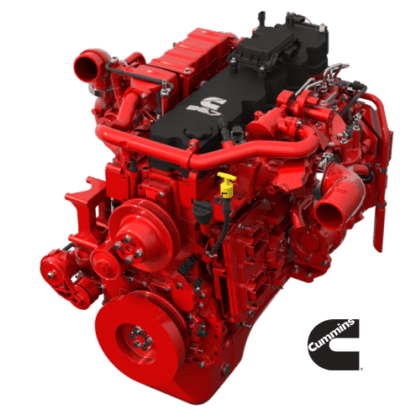
Cummins B6.7 : complete technical specifications
The entire L Series is based on the same proven engine. Here are its detailed technical specifications.
| Features | Technical details |
|---|---|
|
🔢
Displacement Total cylinder volume |
6.7 L - Bore 4.21" × Stroke 4.88 |
|
⚙️
Architecture Mechanical block configuration |
6 in-line cylinders, water-cooled |
|
💉
Power supply Injection and supercharging system |
High-pressure common-rail injection + turbocharger |
|
⚡
Maximum power Depending on calibration L6, L7 or L8 |
Up to 260 HP @ 2,500 rpm |
|
💪
Maximum torque Available early in the rpm range |
Up to 660 lb-ft @ 1,500-1,600 rpm |
|
🌿
Anti-pollution system Compliance with environmental standards |
EGR + DPF particulate filter + SCR (Single Module Aftertreatment) |
|
🛑
Engine brake Reduced wear on service brakes |
Exhaust brake integrated as standard |
|
🛡️
Motor warranty Extendable Cummins program |
Basic 3 years / unlimited mileage and Up to 5 years / 480,000 km (Cummins program) |
Why B6.7?
With over 13 million units produced, the Cummins B6.7 is one of the most reliable and widely used medium-duty engines in North America. Standardization across the L Series simplifies maintenance, parts inventory and technician training.
The exhaust brake deserves special attention. On the South Shore, with its many stops, commercial areas and dense traffic, this system can significantly reduce wear on service brakes, improve vehicle control when descending or slowing down, and reduce maintenance costs on brake pads and drums.
5. Allison transmissions: 2200RDS, 2500RDS and 3000RDS
5.1 Allisson RDS / HS logic
Allison uses two main families of calibrations for the L Series:
RDS (Rugged Duty Series): standard calibration, optimized for intensive commercial use with stop-and-go cycles, heavy loads and frequent starting. This is the work transmission par excellence.
HS (Highway Series): alternative calibration for long wheelbases or more highway configurations. Available as an option on L6 and L7 (long wheelbases).

Allison 2200 RDS, 2500 RDS and 3000 RDS: comparison
Chaque modèle de la Série L reçoit une boîte Allison adaptée à son niveau de charge et à ses usages. Here are the key differences.
| Features | Allison 2200 RDS (L6 - standard) |
Allison 2500 RDS (L7 - standard) |
Allison 3000 RDS (L8 - standard) |
|---|---|---|---|
|
🔢
Number of reports Forward gears |
6 reports |
6 reports |
6 reports |
|
🚛
Target application Recommended use |
Delivery, service, urban cycles |
Medium to heavy loads |
Heavy-duty, bulk, towing |
|
⚖️
Maximum supported GVW Box capacity |
~26,000 lb |
~33,000 lb |
~35,000 lbs+ |
|
⛽
FuelSense 2.0 / 2.0 MAX Automatic consumption optimization |
✓ FuelSense 2.0 |
✓ FuelSense 2.0 |
✓ FuelSense 2.0 MAX |
|
⏸️
Neutral at Stop (NAS) Reduced fuel consumption at idle |
✓ |
✓ |
✓ |
|
⚡
Continuous Power Technology Full-power shifting |
✓ |
✓ |
✓ |
|
🔄
HS option available For long wheelbases / freeways |
✓ Allison 2200 HS |
✓ Allison 2500 HS |
N/A |
|
🛡️
Allison warranty Unlimited mileage |
5 years / unlimited km |
5 years / unlimited km |
5 years / unlimited km |
Things to remember about Allison RDS
The RDS (Rugged Duty Series) is the work calibration par excellence for commercial fleets. FuelSense 2.0 MAX and Neutral at Stop deliver tangible fleet-wide fuel savings, especially on urban cycles with frequent stops.
Allison’s Continuous Power Technology™ ensures seamless, full-power shifts, improving acceleration and handling, particularly in tight spaces and on construction sites. The Neutral at Stop function uncouples the gearbox at standstill, reducing heat generation and fuel consumption at idle. On a fleet with many daily stops, these gains add up significantly on an annual basis.
6. High-strength chassis: 80,000 PSI (L6/L7) and 120,000 PSI (L8)
6.1 Why the chassis is crucial
The chassis is literally the backbone of the truck. It supports not only the payload, but also the body (van, tipper, flatbed, equipment), the torsional stresses associated with maneuvering and rough roads, and the dynamic forces associated with repeated braking, starting and loading. An inferior chassis will deform, crack or transfer stresses to the bodywork, generating significant costs over 5 to 10 years of operation.
80,000 PSI vs 120,000 PSI: which chassis for which use?
The structural strength of the chassis is a key factor in the truck's longevity and compatibility with heavy bodies.
| Features | L6 | L7 | L8 |
|---|---|---|---|
|
🏗️
Steel strength Psi of frame rails |
80,000 PSI |
80,000 PSI |
120,000 PSI |
|
🎯
Main purpose Type of optimal use |
Delivery and intensive service |
Heavier loads |
Maximum intensive use |
|
💪
Flexural strength Torsion and dynamic stress |
High |
High |
Very high (+50%) |
|
🔧
Body compatibility Supported body types |
Van, light tray, service |
Heavy van, tipper, flatbed |
Heavy-duty tipper, heavy-duty flatbed, intensive utility, bulk |
|
📏
Wheelbases Length options available |
175" à 271" |
187" à 280" |
187" / 205" / 217" / 235" / 253" / 271" |
Why L8 goes to 120,000 PSI
A 120,000 PSI chassis represents 50% more structural strength than an 80,000 PSI chassis. This enables the L8 to absorb the most severe dynamic loads (heavily loaded tippers, bulk, heavy equipment) without any long-term chassis deformation, which also protects the installed bodywork.
The move to 120,000 PSI for the L8 is significant: it represents a 50% improvement in structural strength compared with the L6 and L7 side members. In concrete terms, this enables the L8 to absorb higher dynamic loads, better resist torsion associated with heavy bodywork (tippers, utility equipment) and maintain chassis integrity over an extended service life, even under severe operating conditions. For a fleet whose trucks are working at maximum capacity every day, this is no mere detail: it’s an investment in durability and reduced bodybuilding costs over the long term.
7. Turning radius and urban behavior
The L-Series boasts a wheel turning angle of up to 55°, made possible by its advanced cab design. By comparison, a conventional hooded truck in the same class generally has a much smaller turning angle, which means a larger turning radius and more maneuvering in tight spaces.
In daily operations on the South Shore, this means :
-
Half-turns possible where other trucks have to make several maneuvers.
-
Easy access to entrances to tight platforms.
-
Simplified maneuvering in customer yards or industrial parks.
-
Less wasted time, less stress for drivers.
-
Reduced risk of collision with vehicles or obstacles.
8. Cabin, comfort and standard equipment on the Hino L Series
What's standard on the Hino L Series
The L-Series is already well equipped. Here's everything that comes as standard on the L6, L7 and L8.
| Category | Standard equipment |
|---|---|
|
🪑
Driver's seat Comfort and vibration absorption |
High-back premium fabric seat, air suspension and armrest |
|
👥
Passenger seat For 2 additional passengers |
Premium fabric double seat (2 people) |
|
🚗
Cabin Complete interior finish |
Fully trimmed cab |
|
❄️
Air conditioning All-season thermal comfort |
Standard air conditioning |
|
🪟
Windows and doors Electric controls |
Electric windows and locks as standard |
|
🔍
Mirrors Visibility and safety when maneuvering |
Electric and heated outside mirrors + additional convex (×2) |
|
🎛️
Steering wheel Integrated controls |
4-spoke steering wheel with integrated controls (audio, cruise control) |
|
🌡️
Motor heater Winter cold start |
1,000 W / 120 V block heater as standard |
|
🛣️
Speed control Comfort on regional roads |
Cruise control standard |
|
✨
Exterior Standard aesthetic finish |
Chrome grille as standard |
|
🔒
Specific to Hino L8 Exclusive to model L8 |
Driver-controlled differential lock (standard) |
A cab designed for your drivers
A comfortable driver is a more alert and efficient driver. The L-Series comes with a level of equipment that reduces fatigue at the end of the day, promotes employee retention and contributes to the active safety of your fleet.
9. Options available on the Hino L-Series
Customize your Hino Série L to suit your needs
In addition to the standard equipment, here are the main options available on the L6, L7 and L8 to adapt each truck to your specific operations.
| Category | Available options | L6 | L7 | L8 |
|---|---|---|---|---|
|
🔄
Transmission |
Allison HS - long wheelbases / mixed highway use | ✓ 2200 HS |
✓ 2500 HS |
- |
|
🛞
Suspension |
Hendrickson Air Ride rear (up to 23,000 lb) - sensitive goods, driver comfort | ✓ |
✓ |
✓ |
|
🛡️
Active safety |
WABCO OnGuardACTIVE - Frontal collision mitigation system | ✓ |
✓ |
✓ |
|
🛡️
Active safety |
WABCO OnLaneALERT - lane departure warning | ✓ |
✓ |
✓ |
|
🚪
Cabin |
Extended Cab - enlarged cabin for additional comfort or storage | ✓ |
✓ |
✓ |
|
🔍
Mirrors |
Electrically adjustable, heated chrome mirrors | ✓ |
✓ |
✓ |
|
🎨
Paint |
Choice of metallic and standard colors | ✓ |
✓ |
✓ |
|
⚙️
Wheels |
Alcoa forged aluminium wheels - reduced unsprung weight | ✓ |
✓ |
✓ |
|
🔋
Electric |
3rd additional battery - for energy-hungry bodies or equipment | ✓ |
✓ |
✓ |
|
📡
Connectivity |
GPS radio with Bluetooth and mobile connectivity | ✓ |
✓ |
✓ |
|
🛡️
Warranties |
Extended Cummins warranty - up to 5 years / 480,000 km (transferable on resale) | ✓ |
✓ |
✓ |
Conseil Hino Rive-Sud
Several of these options have a direct impact on your TCO (total cost of ownership): air ride suspension protects your cargo and bodywork, Alcoa wheels reduce weight and WABCO driving aids reduce the risk of incidents. Our team can guide you towards the most cost-effective options depending on your actual use.
10. How do I choose between the Hino L6, Hino L7 and Hino L8?
The right model is chosen first and foremost on the basis of your actual laden weight and your predominant use. Here’s a simple logic:
Which Hino L Series model is right for your fleet?
The right model is chosen on the basis of your actual laden weight, your prevailing usage and your 5-year total cost of ownership. Here's a complete decision matrix for South Shore fleet managers.
| Criteria | Hino L6 | Hino L7 | Hino L8 |
|---|---|---|---|
|
📦
Ideal use profile Type of daily work |
Urban and regional delivery, dry or refrigerated van, service truck |
Heavier loads, long crates, light tippers, loaded platforms |
Heavy bulk, heavily loaded tippers, intensive utility, severe towing |
|
⚖️
GVWR Gross vehicle weight |
~25,950 lb |
~33,000 lb |
~35,000 lb |
|
🏗️
Chassis resistance High-strength steel for side members |
80,000 PSI |
80,000 PSI |
120,000 PSI |
|
🔄
Allison transmission Automatic transmission as standard |
2200 RDS |
2500 RDS |
3000 RDS |
|
🔀
Turning radius Maximum wheel cross-section |
55° |
55° |
55° |
|
🎯
Fleet profile concerned Type of company and fleet |
Delivery, service, contractors, SMEs |
Construction, heavy distribution, platforms |
Bulk, towing, heavy-duty |
|
💰
TCO - Cost per kilometer Base: 60,000 km/year - fuel, maintenance, insurance, depreciation included |
~$1.01/km |
~$1.05/km |
~$1.07/km |
|
📅
TCO - Estimated annual cost Total annual operating costs |
~$60,310/year |
~$62,788/year |
~$64,082/year |
|
📊
Net TCO over 5 years Total cost after estimated resale value |
~301 551 $ |
~313 939 $ |
~320 409 $ |
What these TCO figures really reveal
The difference between the L6 (~$1.01/km) and the L8 (~$1.07/km) is just $0.06/km - a difference of around $3,600/year, while the L8 offers almost 35% more load capacity and a 120,000 PSI chassis. Over 5 years, the net difference between the L6 and L8 is around $18,858. For a fleet whose needs justify the power of the L8, this marginal cost is often amortized within a few months, thanks to its robustness, longevity and reduction in unplanned downtime. TCO calculated on the basis of 60,000 km/year over 5 years, including diesel fuel, preventive maintenance, repairs, insurance, depreciation and estimated resale value. See detailed calculation TCO Hino L6 - TCO Hino L7 - TCO Hino L8.
At Hino Rive-Sud, we can help you analyze your actual load, route and body type data to identify precisely the right model, wheelbase and options for your operating reality.
11. The role of Hino Rive-Sud in the life of your Series L
A well-maintained and well-configured Hino L-Series truck can serve you for hundreds of thousands of kilometers. To achieve this, you need a partner who knows these vehicles inside out.
Hino Rive-Sud accompanies you on :
- Sales: advice on the right model (L6, L7, L8), wheelbase, transmission, options.
- Hino and multi-brand maintenance and repair: trained technicians, specialized tools, field knowledge of B6.7 and Allison.
- Parts and accessories department: OEM Hino and multi-brand parts to reduce lead times and downtime.
- SAAQ heavy vehicle inspection: preparation and inspection in line with regulatory requirements.
- PEP inspection: program support.
- 30-point inspection: comprehensive health check to anticipate problems before they become costly.
FAQ – Hino L Series: L6, L7 and L8
What's the main difference between Hino L6, Hino L7 and Hino L8?
The L6 (~25,500-25,950 lb GVWR) is the versatile model for delivery and service. The L7 (~33,000 lb GVWR) increases capacity for heavier loads. The L8 (~35,000 lb GVWR) is the strongest of the range, with a 120,000 PSI chassis and reinforced axles for the most intensive use.
Why does the Hino L8 have a 120,000 PSI chassis, while the Hino L6 and Hino L7 have 80,000 PSI?
The strength of the chassis must be proportional to the loads and stresses of use. The L8 is designed for the most severe applications (heavy bulk, heavily loaded tippers, massive utility vehicles, towing), which generate the greatest stresses on the structure.
A 120,000 PSI chassis withstands these stresses without deforming, maintaining the body’s integrity over time.
Why do L6 and L7 have a HS option but not L8?
The 2200 HS and 2500 HS options are calibrated for long wheelbases with more mixed driving profiles (urban + highway). The L8 is designed for heavy-duty applications whose driving profile and loads do not justify HS calibration. The 3000 RDS is the optimum standard gearbox for this application.
What does Allison's FuelSense 2.0 MAX technology actually do?
FuelSense 2.0 MAX adapts shifting laws in real time according to load, road profile and driving conditions.
The result: fewer unnecessarily high revs, better energy management and significant fuel savings for the fleet, especially with busy urban cycles.
How does the 55° turning radius of the Hino L Series change everyday life?
For a truck between 23,000 and 35,000 lb GVWR, a 55° steering angle is remarkably tight.
In concrete terms, your drivers maneuver more easily in tight spaces, save time, reduce the risk of fender-benders and end their day less tired.
What sets Hendrickson Air Ride suspension apart and why choose it?
Air ride suspension absorbs vibrations and shocks better than conventional blades.
It is particularly recommended for sensitive cargoes (foodstuffs, electronic equipment, fragile materials) or to improve driver comfort over long distances.
It can also contribute to the longevity of the bodywork.
Are Cummins and Allison warranties transferable when reselling a Hino truck?
In most cases, Cummins warranties (up to 5 years / 480,000 km) and Allison warranties (5 years, unlimited mileage) can be transferred on resale, which is a significant resale value argument for a fleet.
Why choose Hino Rive-Sud for my L Series?
Because you benefit from a local partner on the South Shore who knows the L6, L7 and L8 inside out, can advise you on the right configuration, offers a complete service (sales, maintenance, parts, inspections) and understands the real constraints of the SME fleets in your region.
Recent articles
- All Post
- Employment
- Non classifié(e)
- Security
- Services
- Technology
- Transport
- Truck


